
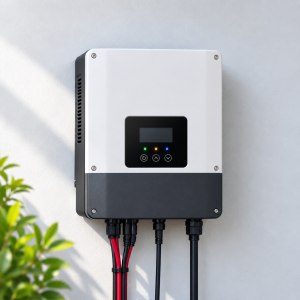
Inverter and Battery Solutions for Africa
Inverters and batteries form the core of many modern
solar and backup power systems.
A properly matched system can combine solar generation,
battery storage, grid electricity and generator backup
while maintaining reliable power to essential loads.
Hybrid Inverters
Hybrid inverters can manage multiple energy sources,
including solar panels, batteries and utility electricity.
Some systems can also integrate generator input.
Browse
solar and hybrid inverters
.
Off-Grid Inverters
Off-grid systems are intended for sites where utility
electricity is unavailable or is not relied upon as
the primary source.
These systems require careful battery and solar sizing
because the inverter must operate independently.
Lithium Battery Storage
Battery storage supports night-time energy use,
grid outages and solar-energy shifting.
Browse
lithium battery systems
or read the
Lithium Battery Storage Guide Africa
.
What Makes an Inverter and Battery Compatible?
- Battery voltage
- Maximum charge current
- Maximum discharge current
- Communication protocol
- Battery-management system requirements
- Inverter firmware
- Manufacturer compatibility approval
Solar, Grid and Generator Integration
A hybrid backup system may use solar during the day,
battery storage during outages, grid electricity
when available and a generator during prolonged
outages or high-load periods.
See
Solar Power Systems Africa
and
Generator Solutions
for related equipment.
Technical References
Victron inverter/charger documentation
provides examples of systems designed for backup,
off-grid and energy-storage applications. Victron
also describes functions such as PowerAssist,
PowerControl and integration with battery systems.
For battery compatibility, consult
BYD Battery-Box compatibility and technical documentation
.
Related Guides Inverters and batteries
Solar Sizing Guide Africa
Lithium Battery Storage Guide Africa
Solar Power Systems Africa
Browse Inverters
Browse Batteries
Choosing Inverters and Batteries for African Projects
Choosing inverters and batteries for a home,
commercial building or remote project requires
an understanding of both electricity demand
and energy-storage requirements.
The inverter determines how much power can be
supplied at a particular moment. Battery capacity
influences how long the connected loads can
continue operating when another supply is
unavailable.
These requirements should be assessed separately
before the components are matched into a
complete system.
Start With the Essential Loads
Prepare a list of the appliances and equipment
that must remain operational during an outage.
Include their rated power, operating hours
and any significant starting requirements.
A small office might prioritize computers,
networking equipment, lighting and security.
A farm could require power for communications,
refrigeration or selected pumping equipment.
Grouping essential loads helps establish a
realistic backup requirement instead of
automatically sizing a system for every
appliance on the premises.
Consider the Installation Environment
Ambient temperature, ventilation, dust,
humidity and available installation space
can influence equipment performance and
service requirements.
Check the manufacturer’s environmental
specifications and provide suitable access
for inspection, maintenance and safe
operation.
Understanding Inverter Power and Battery Energy
Inverter capacity and battery capacity describe
different aspects of a backup system.
Understanding this distinction helps buyers
compare quotations more accurately.
| Specification | What it means | Why it matters |
|---|---|---|
| Inverter power (kW) | Continuous AC output capability | Determines the simultaneous load the inverter can support |
| Surge capability | Short-duration output above normal running power | Important for certain motors and compressors |
| Battery energy (kWh) | Stored electrical energy | Influences potential backup duration |
| Battery voltage | Nominal DC operating voltage | Must be compatible with the inverter |
| Charge/discharge limits | Allowed battery current or power | Can limit charging speed and available output |
Example: Understanding Backup Duration
Suppose a business has an essential load
averaging 1 kW and needs approximately
four hours of backup.
That load requires about 4 kWh of delivered
electrical energy before accounting for
inverter losses, battery operating limits
and additional reserve.
The required nominal battery capacity
will therefore be greater than the
simple load calculation suggests.
This is only an illustrative calculation,
not a finished system design. The actual
equipment must be selected from verified
technical specifications.
For broader system planning, read the
Solar Sizing Guide Africa
.
Battery Compatibility: Beyond Matching Voltage
Two components can have matching nominal
voltages and still be unsuitable for use
together.
Battery-management-system communication
can affect charging control, discharge
limits, operating information and
protective functions.
When evaluating a proposed combination,
check the exact inverter model, battery
model, supported communication method
and applicable firmware versions.
Do not assume that compatibility between
two brands extends to every product
they manufacture.
Compatibility Checklist
- Confirm the inverter’s supported battery voltage range.
- Check maximum charging and discharging currents.
- Review the battery-management communication requirements.
- Verify the exact model against manufacturer compatibility documentation.
- Confirm whether parallel battery operation is supported.
- Check installation and warranty conditions.
- Verify the firmware requirements for the proposed combination.
Applications for Homes, Businesses and Remote Sites
Residential Backup
Residential systems may prioritize lighting,
communications, refrigeration and selected
household appliances.
A backup load schedule can help determine
whether all essential appliances need to
operate simultaneously or whether some
can be managed during an outage.
Commercial Backup
Businesses may require continuity for
point-of-sale systems, networking,
security, refrigeration and selected
operational equipment.
A properly planned system should consider
the financial or operational consequences
of losing each load.
Remote and Off-Grid Projects
Remote installations require particular
attention to available generation,
stored energy, autonomy and equipment
maintenance.
Battery storage may need to support
periods of reduced photovoltaic
generation, making site-specific
energy planning especially important.
Installation and Electrical Protection
Correct installation is essential
for the safe operation of energy-storage
equipment.
- Provide suitable AC and DC isolation.
- Use appropriately rated cables and protection devices.
- Follow manufacturer earthing requirements.
- Provide adequate ventilation and service access.
- Install equipment within its specified environmental limits.
- Keep electrical documentation and configuration records.
- Arrange commissioning by appropriately qualified professionals.
Inverter settings should reflect the
selected battery and intended operating
mode. Incorrect configuration can reduce
performance or create compatibility
and safety problems.
Planning for Future System Expansion
Some projects begin with a modest backup
system and later require additional
battery storage or photovoltaic capacity.
However, expansion possibilities depend
on the capabilities and limitations
of the specific equipment.
Before ordering, confirm whether the
proposed inverter supports additional
storage, parallel operation or other
planned extensions.
Future expansion requirements should
be included in the initial project
brief whenever possible.
What to Check Before Accepting a Quotation
A quotation should identify the exact
equipment being supplied and explain
which additional components and services
are included.
- Manufacturer and complete model numbers.
- Continuous output and surge specifications.
- Battery capacity and usable-energy assumptions.
- Verified inverter and battery compatibility.
- PV input specifications, where applicable.
- Required cables, protection and mounting equipment.
- Monitoring and communication provisions.
- Warranty terms and technical support.
- Delivery, installation and commissioning scope.
- System documentation and operator guidance.
For more purchasing considerations,
visit our
Power Equipment Buying Guide Africa
.
Frequently Asked Questions
Can I use any lithium battery with a hybrid inverter?
No. Voltage compatibility alone is insufficient.
Check supported battery models, operating limits,
communication requirements and firmware compatibility.
How many batteries do I need?
The number depends on essential load demand,
required backup duration, usable battery
capacity and the operating limits of
the proposed equipment.
Can an inverter work without solar panels?
Some inverter/charger systems can operate
with compatible battery storage and
another supported charging source.
The available modes depend on the
specific model.
Can I expand my battery storage later?
Expansion may be possible where the
manufacturer supports the intended
battery configuration and system design.
Confirm compatibility before purchasing.
Can an inverter work with a generator?
Some systems support generator input
or integration through suitable controls.
The generator, inverter and protection
arrangement must be designed to operate
together correctly.